






Enterprise-Grade Trust Starts With Smarter Certificate Management
We cannot underestimate the role of digital certificates for establishing trust in modern businesses. They verify identities and secure communication while protecting data and authenticating software and services. Applications and devices require constant secure connections to function; APIs communicate with microservices; and users access workloads across distributed systems. Digital certificates make all of this possible. Now, as organizations are expanding across hybrid and multi-cloud environments, the number of certificates is also growing. What looks manageable quickly becomes thousands of certificates scattered across infrastructure, which creates real operational and security risks. Smarter certificate management helps teams move away from last-minute fixes and toward proactive control.
Quick Answer
Smarter certificate management replaces manual spreadsheets with automated discovery, issuance, renewal, and monitoring of every digital certificate across hybrid and multi-cloud infrastructure. It closes visibility gaps, prevents expiration driven outages, and keeps organizations audit ready as public TLS certificate validity shrinks toward 47 days, turning certificate operations into a proactive process instead of a recurring emergency.
Executive Summary
Certificate volumes are growing faster than manual processes can track them, and shrinking validity periods are compounding the problem every renewal cycle. The sections below give PKI, security, platform, and compliance teams a shared starting point: what to check first, who owns which task, and what to do in the next quarter.
Quick Checklist
- Inventory every certificate across public servers, private networks, cloud workloads, and IoT devices.
- Confirm private keys are stored in an HSM or cloud KMS rather than sitting on individual servers.
- Set renewal automation in place before validity periods shrink further toward 47-day cycles.
- Verify an audit trail exists for every certificate issuance, renewal, and revocation event.
- Assign clear, named ownership for PKI, security, platform, and compliance responsibilities.
Owner and Action Matrix
| Team | Primary Responsibility | First Action |
|---|---|---|
| PKI Team | Own certificate authority relationships and issuance policy | Run a full certificate discovery scan this quarter |
| Security Team | Flag weak algorithms, short key lengths, and shadow certificates | Enforce an approved certificate authority and key length policy |
| Platform Team | Automate renewal inside CI/CD and infrastructure pipelines | Pilot automated renewal on one production workload |
| Compliance Team | Produce audit ready certificate evidence for regulators | Define the reporting fields auditors will request next cycle |
What Is Smarter Certificate Management?
Smarter certificate management means replacing manual spreadsheets and calendar reminders with automated systems that handle everything from discovery to renewal. Instead of hunting down certificates across your infrastructure or scrambling to renew them before they expire, intelligent platforms continuously scan your entire network to find every certificate on public servers, private networks, cloud workloads, and IoT devices. A centralized inventory is maintained, so nothing gets lost. When teams need new certificates, the system issues them instantly while enforcing your security policies on key lengths, algorithms, and validity periods.
Renewals happen automatically weeks before expiration and get installed without downtime. Private keys stay protected in HSMs or cloud KMS rather than sitting on vulnerable servers. Real-time monitoring alerts you to problems before they cause outages. The result is simple: your organization stops firefighting certificate issues and starts running a reliable cryptographic infrastructure that scales with your business.
Why Is Smarter Certificate Management Becoming Non-negotiable
- Certificate Lifespans Keep Shrinking: Shorter certificate lifespans mean more frequent renewals. The CA/Browser Forum’s Ballot SC-081v3, approved April 11, 2025, phases maximum public TLS certificate validity down to 200 days in March 2026, 100 days in March 2027, and 47-day TLS certificates by March 2029 (source: Sectigo, April 14, 2025). What was manageable manually at 2-year certificates becomes impossible once renewals happen every 47 days.
- Zero-Trust and Compliance Demand Automation: Zero-trust architecture requires cryptographic identity for every device and workload, while regulations like PCI-DSS and HIPAA demand documented proof of proper certificate management. Only automated systems can provide the crypto agility and audit trails regulators require at machine identity scale.
- Outages Cost Millions in Minutes: Expired certificates bring down critical systems without warning, and this is more common than most teams assume: 45% of organizations reported certificate-related downtime in the past year, and 37.5% traced an outage directly to an expired certificate. Among affected organizations, 31% reported losses between $50,000 and $250,000, and 18.5% reported losses exceeding $250,000, on top of reputational damage that drives customers away (DigiCert Trust Pulse Survey, July 2, 2025).
- Certificate Volumes Are Exploding Across Hybrid Environments: Modern enterprises manage thousands of certificates across servers, cloud workloads, containers, IoT devices, and APIs spread across AWS, Azure, GCP, and on-premises infrastructure. Manual tracking breaks down completely at this scale, which is why continuous certificate discovery matters as much as renewal itself.
- Security Breaches Exploit Certificate Weaknesses: Attackers use compromised or weak certificates to impersonate systems, decrypt traffic, and sign malicious code. A single misconfigured certificate creates an entry point to your entire infrastructure.
Building Your Own Certificate Management Strategy
- Start with a comprehensive audit. Scan your entire infrastructure to find every certificate on public servers, internal systems, cloud platforms, and DevOps pipelines. Identify gaps in visibility, quantify manual processes, and assess your risk from expired or misconfigured certificates.
- Define clear, organization-wide policies. Set standards for certificate types, minimum key sizes, approved algorithms, and validity periods. Establish who can request certificates and what approval workflows look like. These policies eliminate inconsistency across teams.
- Select a certificate automation platform that offers discovery, lifecycle management, and policy enforcement. The solution needs strong APIs for custom workflows and integration with your existing security tools. Automation should handle issuance, renewal, and revocation without constant human intervention.
- Establish ownership and governance. Assign accountability for certificate management. Create runbooks for common scenarios and incident escalation procedures. Make sure teams know who to contact when problems occur.
- Plan for future requirements now. Assess your PQC readiness for the post-quantum cryptography migration ahead and prepare for shorter certificate lifespans as industry standards evolve. Build flexibility into your strategy so you can adapt to new threats or regulations as they emerge.
The Business Impact
Smarter certificate management prevents costly outages and shifts teams away from repetitive certificate tasks toward strategic security work. Centralized visibility eliminates shadow certificates and ensures compliance with regulations like PCI-DSS and HIPAA. Automated audit trails simplify regulatory reviews and reduce the risk of penalties. Centralized visibility also feeds a cryptographic bill of materials, or CBOM, that turns a certificate inventory into an intelligence layer teams can reuse for future audits and post-quantum migration planning.
The renewal workload itself is about to compound. The CA/Browser Forum’s current maximum public TLS certificate validity is 398 days, and Ballot SC-081v3 phases that down to 47 days by March 2029. For the same certificate inventory, that shift means renewing roughly eight times more often, a workload manual tracking cannot absorb at any meaningful scale of infrastructure.
When vulnerabilities emerge, platforms can quickly replace affected certificates across the infrastructure. This agility matters as the industry adopts post-quantum algorithms and shorter lifespans. Consistent uptime protects brand reputation. Organizations that treat certificate management strategically rather than as IT maintenance build lasting competitive advantages.
Decision Checklist: Matching Use Cases to the Right Action
Not every certificate problem needs the same response. The table below maps common use cases to a recommended action, the team that should own it, and the outcome you should expect once it is in place.
| Use Case | Recommendation | Operational Owner | Expected Outcome |
|---|---|---|---|
| Public-facing TLS certificates issued by multiple CAs | Deploy ACME-based automated issuance and renewal | Platform/DevOps Team | No manual renewal touches, no expiry-driven outages |
| Certificates issued outside sanctioned PKI workflows | Run continuous certificate discovery across networks and cloud accounts | Security Team | Full inventory visibility, shadow certificates eliminated |
| Private keys tied to high-value certificates | Move private keys into an HSM or cloud KMS instead of local servers | PKI Team | Lower key-theft risk and stronger audit posture |
| Compliance reporting for PCI-DSS or HIPAA audits | Generate automated, audit-ready certificate reports on demand | Compliance Team | Faster audit cycles with documented control evidence |
| Preparing infrastructure for post-quantum migration | Build a CBOM and start a formal PQC readiness assessment | PKI and Security Leadership | A migration roadmap ready ahead of industry deadlines |
What to Do Next
Once ownership is assigned, each team has a distinct next step to move from awareness to a working program.
- PKI teams should expand the discovery scan to cover every certificate authority currently in use, then compare key lengths and algorithms against current policy.
- Security teams should cross-reference discovered certificates against the approved CA list, flag self-signed or shadow certificates, and route certificate alerts into existing monitoring tools.
- Platform teams should enable ACME protocol support in build and deployment pipelines, then replace manual renewal scripts with automated hooks and test failover behavior.
- Compliance teams should map certificate controls to the specific PCI-DSS or HIPAA requirements they support, then schedule a recurring evidence review ahead of the next audit cycle.
How Encryption Consulting Can Help
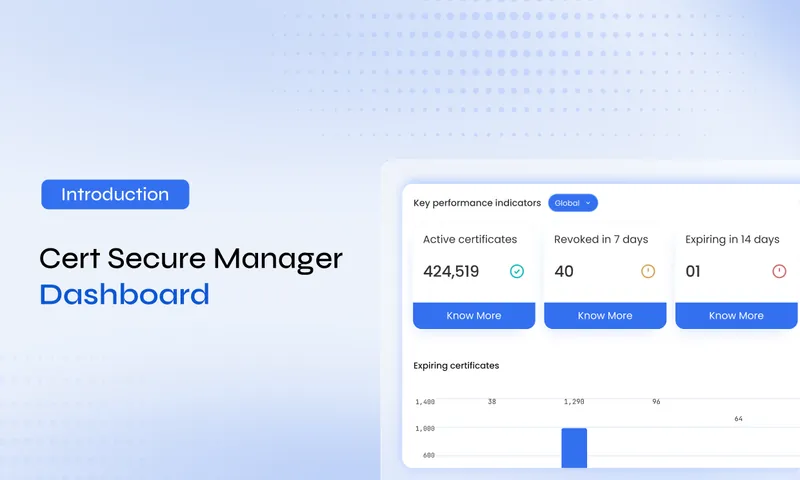
We at Encryption Consulting can transform manual certificate management into automated solutions through our CLM solution, CertSecure Manager. Our vendor-neutral system connects all public and private certificate authorities into unified management. You get a centralized certificate inventory, automated renewals for your SSL/TLS endpoints, continuous discovery across your infrastructure, better audit capabilities, automated reports, and essential alerts before expiration. With our CLM solution and other PKI-related services, you can rest easy and achieve smarter certificate management for your organization.
Conclusion
Enterprise-grade trust is not built on hope and manual processes. It requires intelligent automation, comprehensive visibility, and proactive management of digital certificates. The question is not whether to modernize certificate management but how quickly you can implement practices that match the scale and complexity of modern enterprise IT. Organizations that invest in smarter certificate management do not just reduce operational burden; they build resilient infrastructure that customers, partners, and regulators can trust.
Frequently Asked Questions
Enterprise trust depends on treating certificate management as continuous, automated infrastructure rather than a manual checklist. Once an organization can discover, issue, renew, and monitor every certificate automatically, it stops firefighting expirations and starts operating a cryptographic infrastructure that scales safely.
A certificate lifecycle management program that still relies on spreadsheets cannot keep pace once validity periods shrink toward 47 days, so automated management is what keeps discovery, issuance, and renewal accurate as certificate volume grows across hybrid and multi-cloud infrastructure.
The PKI team owns discovery and certificate authority relationships, the security team owns flagging weak keys and shadow certificates, the platform team owns automating renewal inside CI/CD and infrastructure pipelines, and the compliance team owns producing audit-ready evidence for regulators.
Manual tracking misses certificates issued outside sanctioned workflows, leaves private keys sitting on vulnerable servers instead of an HSM or KMS, and cannot scale once validity periods shrink, which is how unexpected outages and failed audits happen.
Automated discovery finds every certificate across public servers, private networks, and cloud workloads, while automated renewal installs replacements weeks before expiration and real-time monitoring flags problems before they interrupt service, removing the manual step where outages usually originate.
Useful metrics include the percentage of certificates under centralized, automated management, the number of previously unknown or shadow certificates discovered, average time to renew before expiration, and the reduction in certificate-related incidents quarter over quarter.
As the CA/Browser Forum’s Ballot SC-081v3 phases maximum public TLS certificate validity to 200 days in 2026, 100 days in 2027, and 47 days by 2029, the renewal workload for the same certificate inventory grows roughly eightfold, which only automated issuance and renewal can absorb without added headcount.
Multi-cloud and hybrid PKI environments need a platform that discovers and manages certificates across AWS, Azure, GCP, and internal certificate authorities from one console, since a tool built around a single provider cannot produce the unified inventory these environments require.
Certificate lifecycle management describes the full set of stages a certificate moves through, from issuance to renewal to revocation, while smarter certificate management refers specifically to automating and centralizing those stages so they run continuously instead of depending on someone remembering to act.
A practical first 90 days starts with a full discovery scan to build a certificate inventory, moves to defining issuance and key-length policies in weeks four through six, and closes by piloting automated renewal on one production workload before expanding coverage organization-wide.

Every Layer of Cryptography.
One Team to Secure It.
See how Encryption Consulting secures what your enterprise depends on, from assessment through deployment.
Request a Demo